

We get this question a lot: "Where is this written down? How do we know Meta actually wants this?"
Fair question. If someone tells you to restructure your entire ad account around creative volume and broad audiences, you should ask for receipts.
Here are the receipts.
What Meta Officially Recommends
Meta's guidance has been consistent and increasingly explicit over the past two years. It comes down to three pillars: load up on diverse creative, let the algorithm match ads to people, and stop fragmenting your campaigns.
1. At Least 20 Diversified Ads Per Campaign
This isn't a suggestion from a blog post or a conference talk. This is Meta's own published recommendation for Advantage+ Shopping campaigns:
"We recommend maintaining at least 20 diversified ads in Advantage+ shopping campaigns and dedicating 20-30% of your overall ad budget towards testing new ads."
"Launch new ads into your Advantage+ shopping campaigns with regular frequency."
— Three Steps to Optimize Your Performance with Creative Diversification, Meta for Business
And the system can handle it. Advantage+ Shopping supports up to 150 creative combinations in a single campaign.
But volume alone isn't the point. The ads need to be genuinely different:
"Instead of producing a fixed volume of ad creatives per campaign and refining them, consider building a broad portfolio of assets. By uploading ads that are truly distinct in their visuals, messaging, and formats, marketers expand the range of options our system can use to reach different audiences."
— Demystifying Creative Diversification, Meta for Business
The key phrase: "truly distinct in their visuals, messaging, and formats." Not color swaps. Not headline variations. Fundamentally different creative concepts.
2. The Algorithm Matches Creative to People
This is the part that changes how you think about funnel strategy. Meta's AI doesn't just optimize for clicks — it learns which creative resonates with which person at which moment.
"Meta Andromeda comes in, working behind the scenes to power more complex AI models that can better personalize which ads we show someone."
— Unlocking the Power of Diversification with Meta Andromeda, Meta for Business
"By featuring the same product through various angles like price, performance or ease of use, you give our algorithm the flexibility to match your most relevant message to the right person at the right time."
— Creative Differentiation, Meta for Business
And the flip side — what happens when your creative isn't diverse enough:
"When creative is too similar, our system may not recognize it as different and could deliver it to the same sets of audiences."
— Creative Differentiation, Meta for Business
Read that again. If your ads all sound the same — all urgency-driven, or all awareness-level — Meta treats them as one thing and shows them to the same people. You're not testing. You're cannibalizing.
3. Fewer Campaigns, Broader Audiences
Meta wants you to consolidate. Less fragmentation, more signal for the algorithm to work with.
"Combining similar ad sets may help you spend your budget more efficiently and reduce cost per outcome."
— Combine Ad Sets for Faster Results, Meta for Business
"By targeting the broadest possible audience, you enable our system to find more potential customers."
— Advantage+ Audience, Meta for Business
The numbers back it up. Median CPA improvements with Advantage+ Audience (at 99.9% confidence):
- Upper funnel: 14.8% lower CPA
- Middle funnel: 9.7% lower CPA
- Lower funnel: 7.2% lower CPA
Meta Is Forcing the Shift
This isn't just guidance you can ignore. Meta is actively removing the manual controls that let advertisers do things the old way:
- January 2025: Removal of detailed targeting exclusions — fully removed by April 2025. Median cost per conversion was 22.6% lower without them.
- January 2024: Expanding Advantage Detailed Targeting — for link clicks and landing page views, Advantage detailed targeting is now automatically applied with no opt-out.
- January 2022: Removing certain ad targeting options — removed targeting options related to sensitive topics.
The trend is clear and consistent: Meta is taking away manual audience controls and replacing them with AI-driven delivery. Advertisers who lean in — broader audiences, more creative — are rewarded. Those who fight it pay more.
Now, the Honest Part: What Meta Doesn't Say
Here's where we need to be transparent.
Meta does not explicitly tell advertisers to "put TOF, MOF, and BOF creative in the same campaign." You won't find those words in any official Meta documentation. Their guidance is framed around creative diversity — different formats, visuals, messaging angles, and product features — not funnel stages by name.
The funnel distribution strategy — loading a single Advantage+ campaign with awareness hooks, consideration content, and conversion closers — is a best practice built on top of Meta's official guidance. Here's the logic chain:
- Meta says: Consolidate into fewer campaigns. (Official.)
- Meta says: Diversify creative across angles and messaging. (Official.)
- Meta says: The algorithm matches the right creative to the right person. (Official.)
- Therefore: Include creative that speaks to different stages of awareness so the algorithm has the right message for cold prospects, warm audiences, and ready-to-buy customers. (Industry best practice.)
Steps 1-3 are documented. Step 4 is the strategic interpretation that top performance marketers apply on top. It works — we see it in our own accounts every day. But the distinction matters. Meta gives you the building blocks and the machine learning. The funnel-stage framework for organizing creative variety is the strategic layer agencies like us apply.
The closest thing to a manual funnel lever Meta still offers in Advantage+ Shopping is the existing customer budget cap, which lets you split spend between new and existing customers. Everything else — which person sees which ad at which moment — is handled by the algorithm.
What This Looks Like in Practice
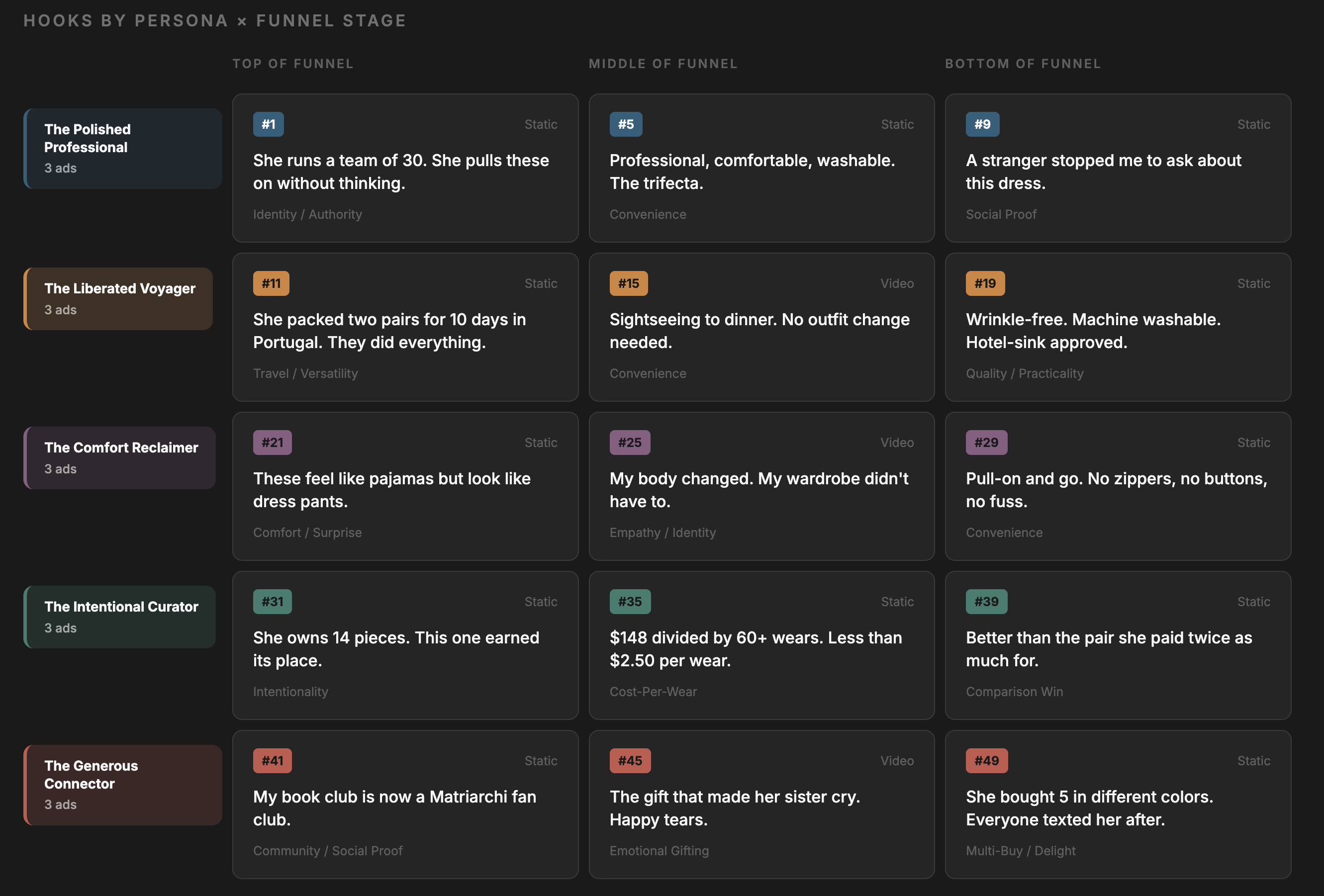
When we build a creative matrix for a client, every concept is mapped across three awareness stages:
- Top of Funnel (TOF): Pattern interrupt, curiosity, problem awareness. The person has never heard of you. You need a hook that stops the scroll and makes them care. "Standing mats for people with taste."
- Middle of Funnel (MOF): Social proof, education, consideration. They've seen you before. Now they need reasons to believe. "20+ colors and sizes — your kitchen's match is in here."
- Bottom of Funnel (BOF): Testimonials, urgency, risk reversal. They're close. They need the final push. "She debated for months. Then bought three."
We don't run separate campaigns for each stage. We load all three into one Advantage+ campaign and let the algorithm decide who sees what. The algorithm is better at this than any media buyer — it has data on the individual user that no targeting parameter can capture.
But the algorithm can only match the right message to the right person if the right message exists in the creative set. If you only feed it BOF urgency ads, it has nothing to show a cold audience. If you only feed it TOF awareness hooks, it has nothing to close with.
Format diversity matters too. Every awareness stage needs coverage across static images, short video, long video, and carousel. Meta's own data shows that different people respond to different formats — and they've built the system to handle up to 150 combinations per campaign for exactly this reason.
How Do You Know When Meta Changes What It Wants?
This is the other question we hear a lot. If Meta keeps shifting the rules, how do you keep up?
The honest answer: the big shifts are less frequent than you'd think, and they're well-telegraphed.
1. Meta Announces It
Product launches, targeting deprecations, and best practice updates all land on Meta's Business Blog and the Developer Blog. Every source linked in this article came from one of these two channels. The cadence is roughly 1-2 major shifts per year, with smaller tuning changes quarterly.
2. Your Performance Data Tells the Story
CPM divergence by format is the clearest signal. If video CPMs drop 20% while static CPMs rise, Meta is incentivizing video. If Reels delivery jumps from 10% to 35% of your impressions, Meta is telling you to feed it more vertical content. These signals show up in your own reporting weeks before anyone writes a blog post about it.
3. Product Launches = Incentive Windows
When Meta launches a new format or campaign type, they subsidize early adopters with cheaper inventory for 3-6 months. Advantage+ Shopping, Reels ads, and Flexible ads all followed this pattern. The first brands to adopt got a CPM discount. The last ones in paid market rates.
4. Targeting Deprecations = Forced Migration
When Meta removes a feature — detailed targeting exclusions, interest-based audiences — the message is clear: stop doing that and let the algorithm handle it. These deprecations are always announced months in advance. If you're paying attention, you're never caught off guard.
The consistent direction since 2022: more creative, broader audiences, fewer manual controls. That trend hasn't reversed once. Every product update, every deprecation, every new feature pushes the same direction. The safest bet is that it continues.
The Numbers, All in One Place
Every number below comes from official Meta documentation:
| Metric | Number |
|---|---|
| Recommended ads in Advantage+ Shopping | At least 20 |
| Max creative combinations per campaign | 150 |
| Budget for testing new creative | 20-30% |
| CPA improvement (Advantage+ Audience) | 7-15% lower |
| Cost per conversion without targeting exclusions | 22.6% lower |
| Advantage+ Sales cost per result | Up to 20% lower |
| Learning phase events needed | 50 in 7 days |
| Max learning phase budget | Under 20% of total |
The Bottom Line
Meta's official guidance is clear: diverse creative, broad audiences, consolidated campaigns. The algorithm does the targeting. Your job is to give it enough variety that it has the right message for every person it finds.
The funnel-stage framework — mapping creative across TOF, MOF, and BOF — is how we organize that variety so nothing gets missed. Meta doesn't prescribe it by name, but it's the logical conclusion of everything they do prescribe.
Give the algorithm awareness hooks for cold audiences, social proof for warm ones, and conversion closers for hot ones. Put them all in one campaign. Let Meta do what Meta does best.
That's what "give Meta what it wants" means. And for once, they actually wrote it down.